Click here to see an excellent rendering of the 40th Anniversary Poster LANta Commissioned earlier this year by local artist, Paula Yoo, to commemorate the Authority's 40 years of continuous service to the Lehigh Valley Community. The poster depicts a number of milestones and major accomplishments that the Authority achieved along this four decade route.
The poster was unveiled at the 40th Annual Board of Directors Meeting held at the America on Wheels Museum, Tuesday, July 9th at noon. Even in these austere times, the Authority has developed a logo and several other elements to mark the anniversary.
As noted at the Board meeting, "Here's to the start of the next 40 years!"

Wednesday, July 11, 2012

Tuesday, June 19, 2012
A Successful Launch for LANtaFlex service
One major service change implemented as part of the August 29, 2011 service restructure was the introduction of the first LANtaFlex service. The Route 501 – Macungie/Alburtis Flex which serves the Lower Macungie, Macungie and Alburtis areas. LANtaFlex is a reservation based flexible service which is open to the general public. LANtaFlex service operates within a geographically defined zone. Riders can travel between any two points within that zone and if they are traveling to or from outside of the zone, they can transfer to/from a LANtaBus service at one of the transit hubs within the zone.
The Macungie/Alburtis Flex service was introduced in the area after the fixed route bus service serving these communities was eliminated due to poor performance. LANta felt that the Flex service model may be more effective at serving this area due to its more sparsely developed suburban nature. The implementation of the Flex zone made service available over an expanded area and also extended service over 12 hours each weekday as opposed to peak period only service provided under the previous service model.
 LANtaVan vehicles are used for this service.
RIDERSHIP GROWTH
Ridership on the Macungie/Alburtis Flex has grown steadily since initial implementation. Ridership grew from 318 riders in September 2011 to 380 in May 2012 with a peak of 558 in February.
Average daily trips have grown from 13 in September 2011 to 19 in May 2012 with a peak of 27 in February. The former fixed route services in the area carried an average of 19 daily passenger trips. The average daily total on the Flex service initially fell below this number for the first few months of service but returned to the pre-implementation average by December 2011 and has consistently reached or surpassed that level since.
To maximize the economies of the new Flex model, the LANtaFlex service has been completely integrated into the LANtaVan system in terms of administration and operations. LANtaVan is the region’s coordinated human service transportation network. LANta’s human service transportation contractor, Easton Coach Company, registers users, takes reservation calls, and schedules and operates the service. While LANtaFlex is not the first service of its kind in the country, it is one of the first to be completely integrated into a coordinated human service transportation system.
FINANCIAL PERFORMANCE
The service model and integration into the LANtaVan system has allowed for significant savings over the previous fixed route bus model. In terms of financial performance, the net cost of the Flex model was $9,800 less than what net costs would have been under the fixed route bus model while still expanding service availability in geographical coverage and hours of service.
CUSTOMER SERVICE
LANta’s administrative offices have only received three calls from members of the public with issues regarding the Flex service since the implementation. All three issues were addressed by Easton Coach. Also, LANta reached out to the Human Resources Department at Allen Organ in Macungie, a frequent destination for Flex riders, and asked if they could solicit feedback regarding the service from their employees who use it. They reported that their employees have had no issues with the service and have been very satisfied with the quality and convenience.
FUTURE PLANS
The Macungie/Alburtis LANtaFlex was implemented as a pilot project to determine if this service could be integrated into the LANtaVan system, and it is considered a success. Accordingly, LANta will continue to investigate opportunities to introduce Flex service to other areas of the Valley.
The Macungie/Alburtis Flex service was introduced in the area after the fixed route bus service serving these communities was eliminated due to poor performance. LANta felt that the Flex service model may be more effective at serving this area due to its more sparsely developed suburban nature. The implementation of the Flex zone made service available over an expanded area and also extended service over 12 hours each weekday as opposed to peak period only service provided under the previous service model.

RIDERSHIP GROWTH
Ridership on the Macungie/Alburtis Flex has grown steadily since initial implementation. Ridership grew from 318 riders in September 2011 to 380 in May 2012 with a peak of 558 in February.
Average daily trips have grown from 13 in September 2011 to 19 in May 2012 with a peak of 27 in February. The former fixed route services in the area carried an average of 19 daily passenger trips. The average daily total on the Flex service initially fell below this number for the first few months of service but returned to the pre-implementation average by December 2011 and has consistently reached or surpassed that level since.
To maximize the economies of the new Flex model, the LANtaFlex service has been completely integrated into the LANtaVan system in terms of administration and operations. LANtaVan is the region’s coordinated human service transportation network. LANta’s human service transportation contractor, Easton Coach Company, registers users, takes reservation calls, and schedules and operates the service. While LANtaFlex is not the first service of its kind in the country, it is one of the first to be completely integrated into a coordinated human service transportation system.
FINANCIAL PERFORMANCE
The service model and integration into the LANtaVan system has allowed for significant savings over the previous fixed route bus model. In terms of financial performance, the net cost of the Flex model was $9,800 less than what net costs would have been under the fixed route bus model while still expanding service availability in geographical coverage and hours of service.
CUSTOMER SERVICE
LANta’s administrative offices have only received three calls from members of the public with issues regarding the Flex service since the implementation. All three issues were addressed by Easton Coach. Also, LANta reached out to the Human Resources Department at Allen Organ in Macungie, a frequent destination for Flex riders, and asked if they could solicit feedback regarding the service from their employees who use it. They reported that their employees have had no issues with the service and have been very satisfied with the quality and convenience.
FUTURE PLANS
The Macungie/Alburtis LANtaFlex was implemented as a pilot project to determine if this service could be integrated into the LANtaVan system, and it is considered a success. Accordingly, LANta will continue to investigate opportunities to introduce Flex service to other areas of the Valley.
Tuesday, June 12, 2012
There's an app for that . . .
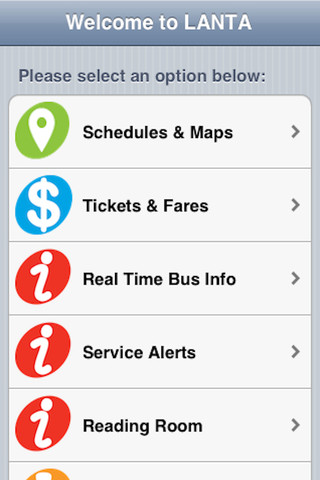 We've been working on an 'app' for the LANtaBus real-time schedule information for some time now and we are sure our customers have been impatient with us. During these 'austere' times, we searched far and wide for the most economical way to have these constructed. We were surprised that our inquiries with the local academic community and those devoted to the advancement of technology were not successful in terms of finding a 'volunteer' to do the programming. Maybe transit is not as 'cool' locally as it is in other communities where students did such apps just because they knew how.
But we did find a company that we've worked now for well over a decade: Connecting People, Inc., managed by the skilled and talented Dan Uff. Dan helped us way back in the early 'net days when LANta had a 'Bulletin Board' online and later when we developed our first web site and now as we enter the 21st Century of technology.
So, the good news, they are done and ready for download. And better news: they are free!! In no particular order:
Android
iPhone& iPod Touch
iPad
The Android app will work with 'Droid telephones and tablets. The iPhone/iPod/iPad apps will work with Microsoft based systems. Use these to explore the system and it's potential to take you where you want to go when you want to go. Use these to plan your trip and check your bus stop. Finally, use these when you get to your bus stop to pinpoint precise information as to when the next bus is REALLY going to arrive based on GPS triangulation.
Hot stuff huh? Did we say it was free? Well, it is.
Thursday, May 24, 2012
How Green is our Valley?
London Bike Share Program not as "green" as had first been reported.
The article is interesting in that certain statistics and functional activities were ignored in trying to make this project appear to be contributing greatly to reducing emissions and providing alternative transit. China has similar projects that have been in place for less than a year and is struggling with maintaining them. It begs the question: is there a 'perfect green' project short of simply not traveling?
 We think not. It appears everything, even 'green solutions' have their challenges.
We had to chuckle when we met an advocate for clean air for the first time and she remarked that it was 'unfortunate' that LANTA was 'part of the problem.' We were taken aback for a moment. Public transit prides itself as being part of the solution to air pollution in that by definition it eliminates so many trips that might otherwise be taken by single occupancy auto. Buses provide such a positive benefit compared to what is exhausted into the air as they operate that the scales are truly weighed in its favor. And technical improvements over the past decade have made 'clean diesel' a good deal more than an oxymoron.
As the advocate continued, it became clear that her focus was on the diesel fuel exhaust from the bus fleet and we have to concur, that is unfortunate. But given current technology and the economics of transit, there isn't really any pure, non-polluting energy alternative to transporting people.
The hybrid electric buses LANTA introduced to the Valley transit system last year go a long way towards minimizing pollutants but they still run somewhat on diesel fuel. And someday, the battery packs that help propel the vehilce will need to be replaced and there is the issue of disposing of batteries and the manufacture of new ones. Both processes have elements of pollution to them.
Obviously, what the world needs is a non-polluting energy alternative to power vehicles. The hydrogen fuel cell is the closest thing we've seen towards that end, but it remains a technology that is considered experimental and not entirely practical for general use.
In the meantime, taking the bus - walking when one can do so practically - is the best alternative for those who want to help the environment.
And it's healthier too!
Wednesday, May 16, 2012
The History of the Bus
LANTA’s 40th anniversary brought to mind the question, how far back does public transportation go? So we did a Google search and found out a few things:
Following their initial inception, buses took some time to catch on as a serious mode of transport.
 Blaise Pascal, yes, the French Philosopher, invented the first public transit system in Paris in 1662. His system made use of horse drawn buses, that followed a set schedule, along published routes and charged a standardized fare based on distance traveled.

Though initially popular, the service lasted for only 15 years before it ceased to operate. This was due to an increase in ticket price which restricted usage to members of high society.
There then followed a huge gap in the history of the bus. There are no records of any other bus services like Pascal’s until the early 19th century, when horse-drawn buses began to appear once more. The ‘Omnibus’ arrived in Bordeaux, France in 1812 and soon after in Paris, New York and London. In these early days, it was common for passengers to also ride on the roof as well as within, with the buses appearing like a hybrid between a carriage and a stagecoach.
The name ‘bus’ is derived from the Latin word ‘Omnibus’ (meaning “for all”). A hatter’s shop which bore the name “Omnes Omnibus” was in close vicinity to the first bus station in Nante, France. Users of the bus quickly adopted the name of Omnibus, which has been shortened over time to ‘bus’.
In the 1830s, steam powered buses were known to be in operation and around the same time, electric trolley buses were developed. The latter buses were powered by overhead cables and in many areas preceded the conventional engine bus (London being one such example) and eventually served as the model for the trolley – a vehicle designed to carry large numbers of passengers powered by electricity that came to the vehicle via a ‘trolley’ or link to an overhead wire.

The first buses powered by internal combustion engines were developed in tandem with the motorcar. Following the first engine powered bus in 1895, the design and functionality developed over the next half century, resulting in the contemporary buses we recognize today.
Electric powered operations moved in three directions: the trolley car on fixed rails, the trolley bus – rubber-tired but tethered to an overhead power line and the ‘third rail’ electric car running on elevated rail lines or underground in tunnels which became known as ‘subways.’ It is worth noting that the day the subway opened in 1904 in New York City, the cars were jammed and it doesn’t appear that there has been any reduction in demand since!
Rubber-tired buses remain the main form of public transportation conveyance all over the world today and probably will for the foreseeable future. If Pascal could have seen into the future, he would be pleased. And amazed.
Following their initial inception, buses took some time to catch on as a serious mode of transport.
 Blaise Pascal, yes, the French Philosopher, invented the first public transit system in Paris in 1662. His system made use of horse drawn buses, that followed a set schedule, along published routes and charged a standardized fare based on distance traveled.
Though initially popular, the service lasted for only 15 years before it ceased to operate. This was due to an increase in ticket price which restricted usage to members of high society.
There then followed a huge gap in the history of the bus. There are no records of any other bus services like Pascal’s until the early 19th century, when horse-drawn buses began to appear once more. The ‘Omnibus’ arrived in Bordeaux, France in 1812 and soon after in Paris, New York and London. In these early days, it was common for passengers to also ride on the roof as well as within, with the buses appearing like a hybrid between a carriage and a stagecoach.
The name ‘bus’ is derived from the Latin word ‘Omnibus’ (meaning “for all”). A hatter’s shop which bore the name “Omnes Omnibus” was in close vicinity to the first bus station in Nante, France. Users of the bus quickly adopted the name of Omnibus, which has been shortened over time to ‘bus’.
In the 1830s, steam powered buses were known to be in operation and around the same time, electric trolley buses were developed. The latter buses were powered by overhead cables and in many areas preceded the conventional engine bus (London being one such example) and eventually served as the model for the trolley – a vehicle designed to carry large numbers of passengers powered by electricity that came to the vehicle via a ‘trolley’ or link to an overhead wire.

The first buses powered by internal combustion engines were developed in tandem with the motorcar. Following the first engine powered bus in 1895, the design and functionality developed over the next half century, resulting in the contemporary buses we recognize today.
Electric powered operations moved in three directions: the trolley car on fixed rails, the trolley bus – rubber-tired but tethered to an overhead power line and the ‘third rail’ electric car running on elevated rail lines or underground in tunnels which became known as ‘subways.’ It is worth noting that the day the subway opened in 1904 in New York City, the cars were jammed and it doesn’t appear that there has been any reduction in demand since!
Rubber-tired buses remain the main form of public transportation conveyance all over the world today and probably will for the foreseeable future. If Pascal could have seen into the future, he would be pleased. And amazed.
[The copy/content for this article was derived from Bus Stuff: A Brief History of the Bus: http://www.bus-stuff.co.uk/2011/01/brief-history-of-bus.html ]
Thursday, May 10, 2012
BRT ... Is that something to eat?
Government is infamous for throwing around acronyms. In transportation, BRT is shorthand for Bus Rapid Transit, a transportation node that is part of the long term vision for public transportation in the Lehigh Valley laid out in the Moving LANTA Forward strategic transportation plan the Authority adopted last year. It’s a term applied to public transportation systems using buses to prov ide a service that is similar to light rail transit without the rails.
 ide a service that is similar to light rail transit without the rails.
It is a form of transportation pioneered in Curitiba, Brazil! Curitiba, one of the fastest growing, most
progressive cities in South America. More than 3 decades ago, Curitiba
initiated municipal planning that merged transit friendly designed with land use. Starting with one line along a major corridor, the mode proved so effective that today, all of Curitiba’s main arteries have express bus lanes that are dedicated to ‘bus rapid transit’ service.
The features of this service: it is quick, has limited stops at boarding platforms and uses rubber-tired vehicles that function and provide amenities more akin to subway or light rail service.
See here: (http://urbanhabitat.org/node/344) for an article with more detail about Curitiba.
See here: (http://www.youtube.com/watch?v=vJR9uCSyGKM) for an excellent video on BRT in Curitiba.
Land use is critical for optimal transit use with higher modes of transportation. LANTA is partnering with Lehigh Valley Planning Commission (LVPC) to dedicate resources to educate the community and municipalities concerning land use and transit oriented design issues.
The Valley already has much of what is needed for an exceptional BRT in place already, but it is not consistent in key corridors.
The Moving LANTA Forward plan calls for service and capital improvements in the short and intermediate terms along “trunk” corridors which can act as a foundation for a future LANTA BRT network. Short and intermediate term service improvements along these trunks include enhancements to the frequency of service an d the hours service is available. Potential capital improvements include passenger amenities, technology and ‘transit first’ improvements.
 d the hours service is available. Potential capital improvements include passenger amenities, technology and ‘transit first’ improvements.
A couple of years ago, there was discussion about ‘rail’ and light rail alternatives in the Valley. When
Congressman Dent responded and explored the concept with the Federal
Transit Administration (FTA) in Washington, given the population density
of the Valley, the FTA recommended looking at BRT as a first step. Congressmen Dent promptly obtained a grant to provide LANTA with funds to examine BRT as an alternative and demonstrate its potential.
LANTA
Planning staff is working now to begin this alternatives analysis as
well as taking steps to define corridors for future BRT projects. Density remains an issue. The Lehigh Valley’s population is 625,000 within Lehigh and Northampton Counties. In urbanized Curitiba, the population is more than twice that: 1.75 million. With
the mature BRT system in place today in Curitiba, 90% of this
population is served. One of the questions that has to be answered is
which comes first: the density or the higher mode of service? Budget issues may resolve the matter, but there is value in planning. And in dreaming.
Wednesday, May 9, 2012
Community Awareness Vol 4 Issue 14
Among LANta’s goals annually, is to reach out to as many people in the community as possible to ensure everyone is aware public transportation is available. We also want to emphasize that the green effects of taking public transportation are many including:
· Reduce air pollution
· Reduce the amount of money spent on personal gas
· Riding a bus is 79 more safer than riding in an automobile
· U.S. reliance on foreign oil would decrease by 40 percent if 1 in 10 Americans used public transportation.
· You are healthier: most rides start with and end with a walk and riding is a lot less stressful than driving
LANta representatives travel throughout the Lehigh and Northampton counties making the community aware of LANtaBus and LANtaVan services. Questions from riders or potential riders are answered and information distributed. Typical questions are how to read the route schedules?, Where to the current routes go? Application and instructions about how to access and ride LANtaVan paratransit are given out. Senior application for the ride free if 65+ program are provided. The new information AVAIL system capabilities are explained and the prices of tickets/passes detailed. We also describe how to use the fare box and what ticket and pass discounts there are. We supply any and all information to ensure everyone’s ride will be smooth sailing and they will become a regular customers.
Some residents do not have ready access to a bus route; therefore, they are unable to access public transportation. Encouraging those with access to public transportation to utilize it more often would allow the entire system to expand and include more frequency and alternative bus routing. This would also create affordable public transportation options in the smaller communities.
Last year LANta presented their information at many events: Musikfest, the Great Allentown Fair, Easton Farmers Market, many senior centers, the annual Senior Expo, health fairs, college campuses, churches, transition schooling, and many community events.
So far in 2012 we have visited Northampton Community College, Allentown’s Bicentennial Celebration event, the Buy LV Chamber Expo, the Allentown Senior Fest, the United Way resource fair, and the Chamber Employee Appreciation Event.
Not many people - neither employees nor employers - are aware that the federal government has tax benefits in order to encourage employees to commute by public transit. These benefits are in the form of tax incentives for businesses to subsidize the cost of bus tickets and passes for employees that can be written off as business expenses. Likewise, these employee benefits are exempt from income tax and pretax wages can be used to purchase tickets and passes lowering the cost even further. For more information about these programs go to:
http://www.commuterbenefitsworkforus.com/learn-about-commuter-benefits.html
If you are aware of any groups (college, church, social, senior center) or businesses that would benefit from this type of presentation or display, call Maryann at 610-435-4052 to set up the date and time.
Subscribe to:
Posts (Atom)